
Switzerland #3 - Zurihac Day 1
Published June 6, 2026
Last day in Luzern
I spent my morning on a boat cruise on Lake Luzern. It’s one of the most highly recommended things to do, but I could’ve done without it. It was cool to get a different view of the mountains, but not for the price. I needed something to do until I could check into my next place though.

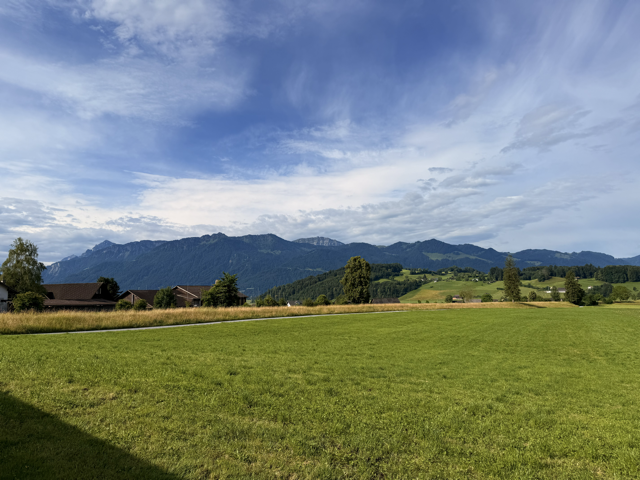
I got here by train, my longest ride yet. There really are mountains and lakes all around here. I then took a bus closer to where I’m staying, and then a half mile walk in the pouring rain to finally get there. The town is Kaltbrunn, about 25 minute commute by public transportation to Zurihac. It is a tiny town with not much to do, but there is a pretty church and some nice nature nearby that I spent a day walking through. I’m preparing for the conference tomorrow.
Zurihac Day 1
I actually got on the wrong bus this morning, but fortunately I had planned to get there half an hour early, so I instead got there about 20 minutes late. The college is right next to the train station, so it was so easy to get to. I immediately ran into some people I had met at Amerihac in January, which was super nice to see some familiar faces. I got a fire T-shirt which is pretty high quality too. Some stats: about 400 people are in attendance, Zurihac has been hosted at the OST Eastern Switzerland University campus in Rapperswil-Jona for 9 years in a row, and Zurihac is organized by the Zurich Friends of Haskell community, which also organizes get togethers every month.
The first keynote was by Simon Peyton Jones, the designer and creator of Haskell who now works for Epic Games designing their Verse language for Fortnite. I have watched a few of his talks before and I knew he talked fast, but without the ability to go back was a different beast. The energy of his talk was crazy, and he would call on people by name in the audience for questions. The Haskell community is a pretty close knit group. His presentation was so good; I thought I had seen all of the programming language features that were possible, but Verse truly does some things new. Although I was struggling to keep up most of the time, there were only a few things I missed (which I am proud of).
After the presentation I got a $20 pizza from a food truck which was pretty good, but I will be stopping by the grocery store tomorrow instead. I talked to a Haskell developer at Tweag during lunch about what he does and what libraries he uses. We also talked about AI and the job market and just about the state of the US and the world. Unfortunately Tweag is not hiring at the moment.
I then took a little tour to see what projects were being worked on, and then went to a presentation about dependent types in Haskell. It was labeled as an advanced Haskell talk, but I thought I would be able to learn something. I don’t know which prerequisites I am missing, but from the very start I had no idea what was going on. I know that dependent types are a way to have static type checking where some of the types depend on the values of other types, but that was clearly not enough. I ended up leaving that presentation early because I had literally no idea what they were talking about.
I then spent some time in the GHC maintainer room. They had said they had some good issues to work on for beginners (even though I don’t think I’m really a beginner), and I wanted to contribute something and gain more experience in the community. The problem is I find these large codebases so impenetrable to understand. Everything is so interdependent I can’t find a way to understand any of it since there are so many prerequisites. I can’t understand what any of the conversations are about; I wish I somehow had 15 years of professional experience.
The 4pm keynote was by Evan Czaplickli, the creator of the Elm language. Evan is pretty much the sole creator of Elm, which is pretty crazy to imagine. The language he developed in his spare time and released publicly for free is the backbone of several million dollar companies, many people got jobs by learning this language, and some people maybe changed their entire trajectory of their life because of his project. His talk was about how to get more people to become functional programmers and how to advertise it. He went through case studies of how companies went about hiring and training people to write in functional languages. One of the companies that uses Elm and Haskell is NoRedInk, whose educational product I am more than familiar with. My students hate it. Evan’s main pitch for functional languages is that they can offer no runtime exceptions with minimal testing required through a strong static typing system. One of the reasons Elm was successful is that it is small and easy to learn, and offered a way to enter functional programming without having to learn something like Haskell with all of its complications. Elm seems like a really cool and pretty powerful language, and I’ve been meaning to revamp this website so I might consider rewriting it in Elm.
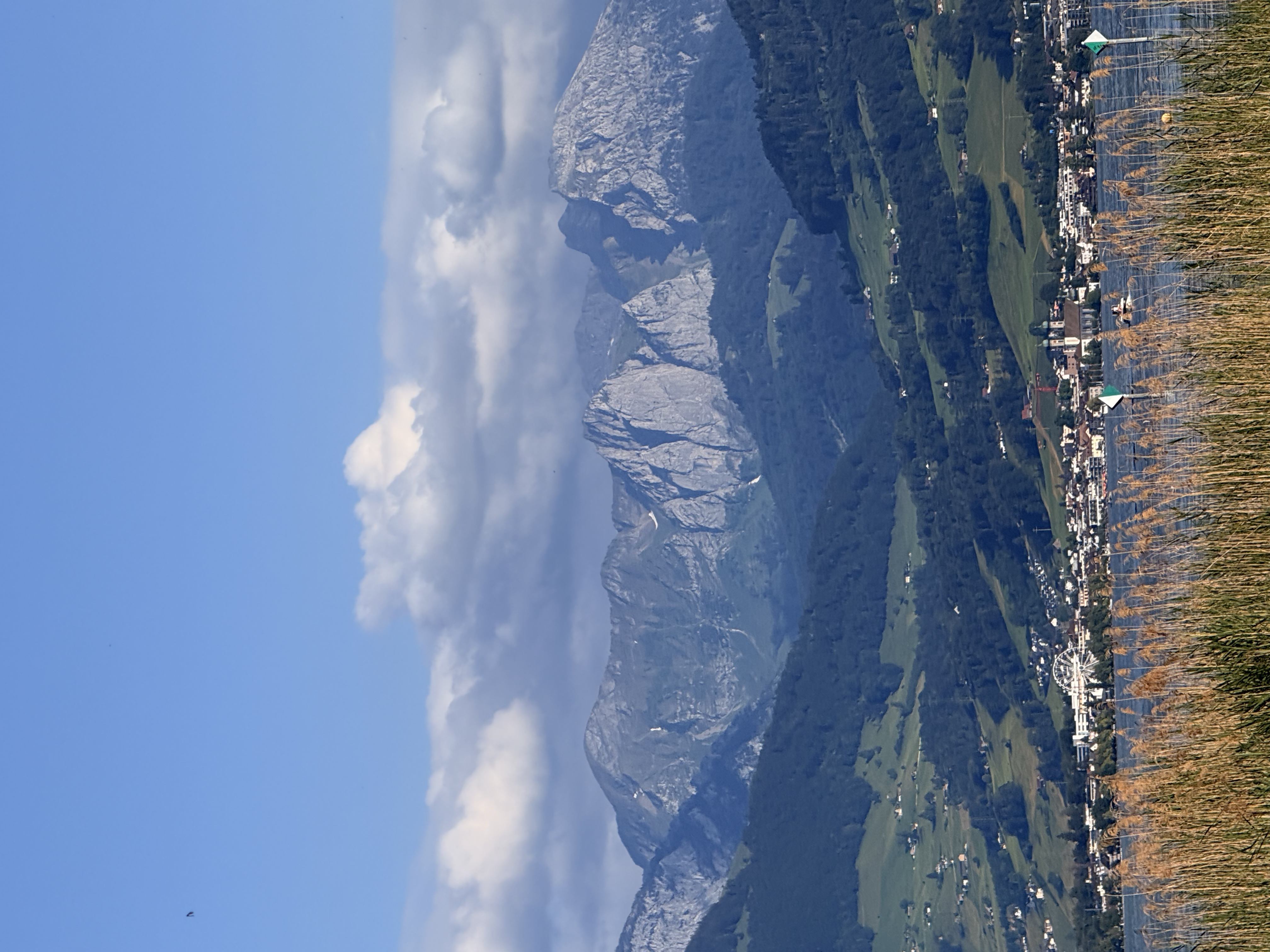
After the talk was dinner. The sausage and chicken was honestly so good. I ate with a few people by the lake, which was just like something out of a dream. The area is so beautiful with the mountains in the background. We spent 4 hours there just talking about Haskell, our experiences and what we hope to do at the conference, and just about our lives. I was with people I’d met before in January; a college student and two professional Haskell contractors, one from the US and one from Switzerland. We went out to a bar after we got kicked out and just continued talking about music and philosophy.
I really hope to find a project and a mentor to guide me through the code. I really like the vibes here and just how cerebral the community is here. The people here truly built some incredibly complicated things like the Haskel compiler and tooling, and have decades of experience maintaining it. There’s not that many young people here, and I have two days to try to find a way in.